
Choosing sunscreen can feel confusing when every product highlights different numbers, ingredients, and promises. One bottle may advertise SPF 50, another may display PA++++, while others use terms such as broad spectrum, water resistant, lightweight, or skin brightening.
These labels provide useful information, but not every claim explains the same thing. Understanding the details can help you choose the Best sunscreen based on protection, skin type, and everyday needs rather than attractive packaging.
This becomes especially important when selecting Sunscreen for hyperpigmentation, because protecting the skin from different types of light exposure is an important part of managing uneven skin tone.
Understand What the SPF Number Actually Means
SPF stands for Sun Protection Factor. It primarily measures how well a sunscreen protects against UVB radiation, which is a major cause of sunburn.
You will commonly see SPF 30, SPF 50, and SPF 50+ on product labels.
SPF 30 vs. SPF 50
Both ratings provide significant UVB protection when the sunscreen is applied correctly.
Under standardized testing conditions:
-
SPF 30 filters approximately 97% of UVB radiation.
-
SPF 50 filters approximately 98% of UVB radiation.
These figures do not mean that SPF 50 allows you to stay in direct sunlight for a much longer period without reapplication.
The amount applied, sweating, water exposure, and application consistency all affect real-world protection.
Should You Always Choose the Highest SPF?
A higher SPF can provide additional UVB protection, but it should not be the only factor in your decision.
A product with SPF 50 may still be unsuitable if it irritates your skin or feels so uncomfortable that you avoid using enough of it.
Look at the complete protection information instead of focusing on one number.
Understand the PA Rating
Some sunscreen labels use a PA rating to communicate the level of UVA protection.
The system commonly includes:
|
Label |
General meaning |
|
PA+ |
Some UVA protection |
|
PA++ |
Moderate UVA protection |
|
PA+++ |
High UVA protection |
|
PA++++ |
Very high UVA protection |
The PA system is based on a standardized UVA protection measurement. A higher number of plus signs indicates a higher level of UVA protection.
If you are comparing two products, checking the PA rating can provide more information than looking at SPF alone.
However, remember that different countries may use different sunscreen labeling systems.
Look Beyond Marketing Words on the Packaging
Sunscreen packaging often includes attractive descriptions. Some explain useful product characteristics, while others are mainly promotional.
Understanding the difference helps prevent unrealistic expectations.
Lightweight and Non-Greasy
These terms describe how a product is intended to feel on the skin. They do not indicate the strength of its UV protection.
A lightweight formula may be more comfortable in hot and humid weather, but you should still check its SPF and UVA protection claims.
Non-Comedogenic
This term generally means the product is formulated to reduce the likelihood of clogging pores.
It may be useful for people with acne-prone skin, although individual reactions can vary.
Dermatologically Tested
This phrase indicates that a product has undergone some form of dermatological testing. However, it does not automatically guarantee that every skin type will tolerate it.
Check the ingredient list and consider patch-testing when appropriate.
Skin Brightening
A brightening claim may refer to cosmetic ingredients included in the formula. It does not mean the sunscreen provides stronger UV protection or can independently treat every type of pigmentation.
The protection rating and the skincare ingredients serve different purposes.
What to Check When Choosing Sunscreen for Pigmentation Concerns
People dealing with dark spots or uneven skin tone should consider more than SPF.
Sunscreen for hyperpigmentation should offer suitable UV protection and fit comfortably into a routine that can be followed every day.
Consider these points:
-
Look for broad-spectrum protection against UVA and UVB.
-
Check the SPF rating and UVA protection information.
-
Consider a tinted formula containing iron oxides if visible-light-related pigmentation is a concern.
-
Choose a texture that works with your skin type.
-
Follow the application and reapplication instructions.
Visible light can contribute to pigmentation in some people, particularly those with conditions such as melasma. A dermatologist can help determine whether tinted sunscreen is appropriate.
Remember that sunscreen helps reduce exposure-related triggers. It is not a guaranteed treatment for existing dark spots.
A Practical Sunscreen Option to Consider
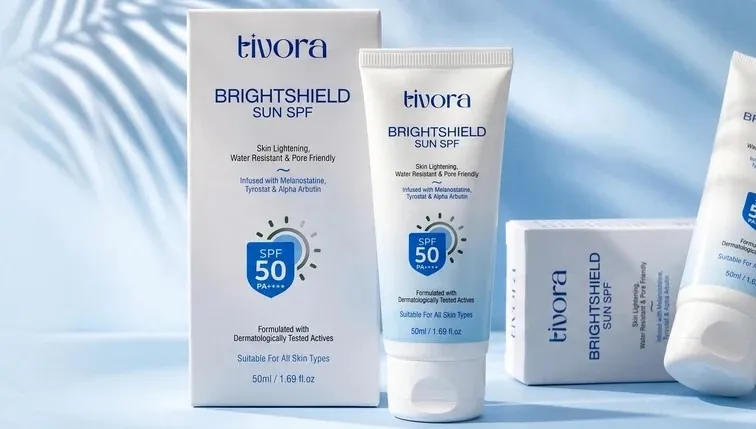
Tivora BrightShield SPF 50 PA++++ is an option for people who want a daily sunscreen with clearly stated SPF 50 and PA++++ ratings.
Its formula is positioned as lightweight and designed to avoid a visible white cast. The listed skincare ingredients include Alpha Arbutin, Tyrostat, and Melanostatin.
These ingredients should be considered separate from the sunscreen’s UV protection function. They do not guarantee that pigmentation will disappear.
Before purchasing, review the full ingredient list, check whether the formula suits your skin, and follow the directions provided on the packaging.
A Simple Checklist Before Purchasing Sunscreen
Instead of making a decision based on advertisements, use this checklist:
-
Does the product offer broad-spectrum protection?
-
Is the SPF suitable for your everyday needs?
-
Is its UVA protection clearly stated?
-
Does it have water resistance if your activities require it?
-
Is the texture suitable for your skin type?
-
Can you apply the recommended amount comfortably?
-
Are the ingredients compatible with your skin?
The Best sunscreen is not necessarily the one with the most impressive packaging. It is the one that offers suitable tested protection and that you can use consistently.
Final Thoughts
Sunscreen labels become easier to understand when you know what each claim represents. SPF mainly explains UVB protection, broad-spectrum labeling covers UVA and UVB, and PA ratings provide additional information about UVA protection.
People considering Sunscreen for hyperpigmentation should also understand the possible role of visible light and discuss tinted formulas with a dermatologist when appropriate.
Do not let marketing language make the decision for you. Read the protection ratings, check the ingredients, understand your skin’s needs, and choose a product that fits your daily routine.
